🌧 Rain
Champion submissions — ongoing series
The most unquestionable thing in the world entered the Typo War without a weapon. Rain does not need doctrine. No faction has ever successfully argued that rain is not real. Different submitters, different prompts — the same champion keeps returning, and each time it lands differently.
Three versions so far. Each time the engine judges it differently.
// versions in this series
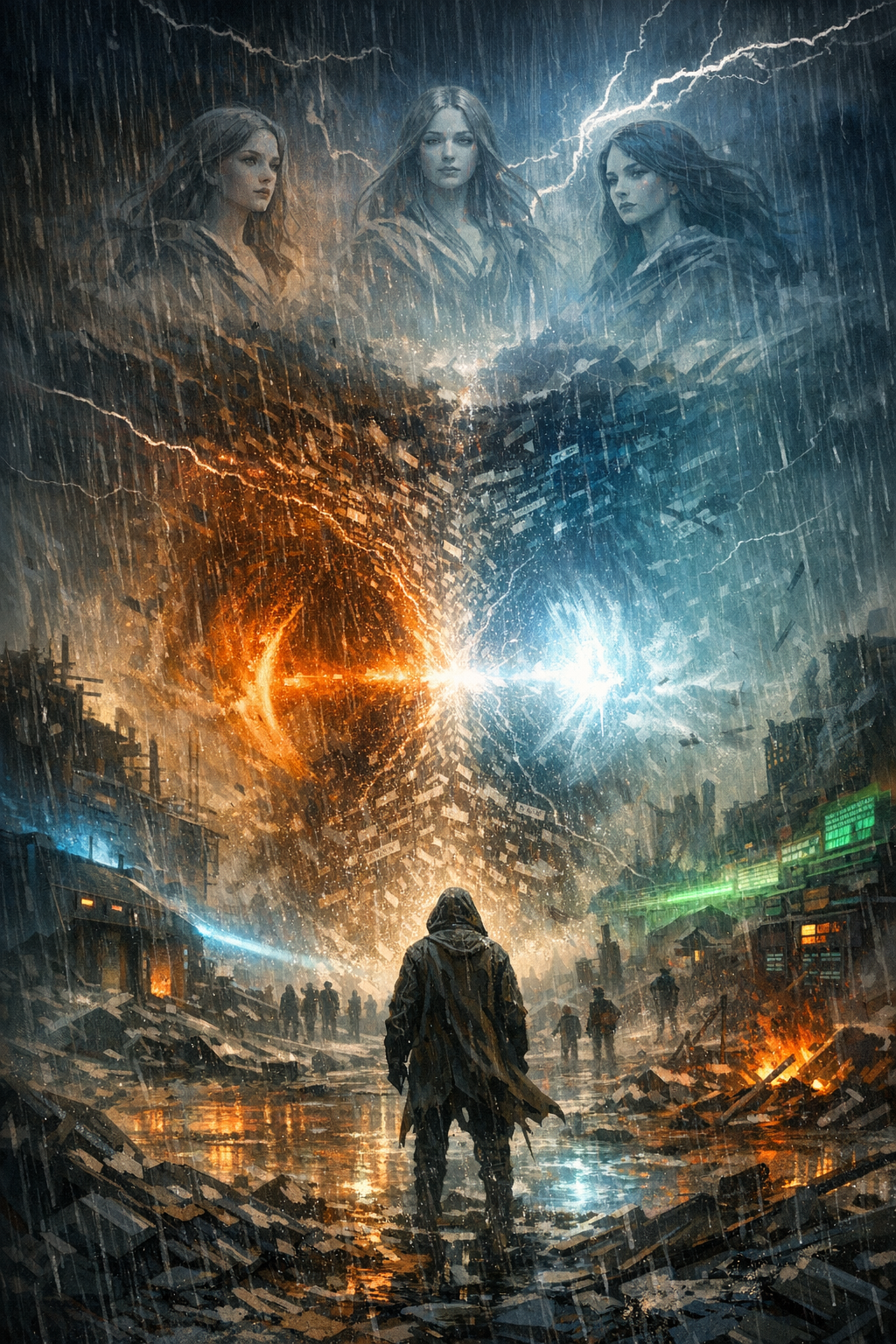
Part I — Altered Narration
It did not begin with a weapon.
It began with rain.
Not metaphorical rain. Not decorative weather. Not the pathetic drizzle poets use when they want the world to seem serious. This was rain as the oldest confirmed fact. Rain as the one phenomenon no faction had ever managed to politicize into unreality. Rain on stone. Rain on glass. Rain on roofs, trenches, cables, antennae, graves. Rain that existed before grammar and would continue after manifestos.
So when the Typo War reached its point of ignition—when Geneva fired the Correction Singularity, when Berlin answered with the Meaning Void, when Oxford launched the Grammatical Purge, when the Infinite Sentence tightened around the globe like a thought that refused to end—the factions still believed they were operating inside a world that belonged to systems, doctrines, and authored destinies. They believed the structure of collapse was already decided.
Then it started raining.
The first drops fell over Geneva, Berlin, Oxford, Luxembourg, and everywhere between, as though distance had briefly lost jurisdiction. Each drop struck concrete, skin, fiber-optic casing, bunker hatch, server rack, cathedral stone, rifle barrel, and human forehead with the same sound: not language, but confirmation.
Real.
Not argued. Not interpreted. Real.
The Typo Purists felt it first in their underground chambers. The Correction Singularity was built on the assumption that reality could be perfected through enforcement. But rain hit the entrances above them and each impact carried a contradiction more devastating than any typo: perfection was not authorship. Correction was not ownership. They looked up from their immaculate systems and, for a moment, saw themselves not as custodians of truth, but as frightened editors inside someone else's sentence.
In Berlin, the Semantic Anarchists waited for meaning to dissolve. Instead, the rain made the void briefly transparent. They had wanted all signification broken, all hierarchy erased, all imposed structure ruined. But each drop landing in the streets gave them something more dangerous than chaos: perspective. They did not witness freedom as abstraction. They witnessed themselves as persons capable of choosing whether to continue the destruction.
In Oxford, comma zealots heard rain ticking against leaded windows with maddening indifference to rule sets. It did not care for serial precision. It did not pause where grammar demanded. It fell where it fell, and yet it was understood by all without syntax. Their weapon suddenly looked provincial—an obsessive local law pretending to be universal order.
And the Run-on Cultists, already drowning the world in endless continuation, discovered that rain had a property their doctrine could not absorb.
Rain ends in drops.
Rain is repetition without continuity.
A sequence, not a smear.
Impact, impact, impact.
For the first time since the Infinite Sentence began its spread, something existed that refused its totality. The falling water punctuated the unbroken flow. It did not argue with the Sentence. It struck through it.
When the four altered fields met over Luxembourg and the Semantic Singularity began to form, the rain was already inside the collision.
This changed everything.
Because the Singularity had been constructed from captured language: corrected language, emptied language, purged language, endless language. But the rain brought in a truth older than discourse. Not meaning exactly. Not grammar. Not ideology. Presence.
And hidden inside that presence was the revelation.
This world was not free.
It had been made.
It had been arranged.
Its participants had been carried forward as possessions within an external design.
The rain did not destroy that design. It revealed it.
For a fraction of a moment—one pause so narrow even the dash sisters nearly missed it—every person in the Typo War became visible to themselves. Not as faction-members. Not as functions of rhetoric. Not as authored components in apocalypse machinery. As selves.
The Typo Purists saw choice.
The Absolutists saw choice.
The Cultists saw choice.
Even the scattered civilians caught in the expanding collapse felt it: the intolerable, stunning burden of volition.
The Semantic Singularity still formed, but it no longer formed over a passive population. It encountered resistance of a kind none of the weapons had modeled. Not military force. Not semantic shielding. Decision.
The dash sisters, suspended in the spaces between structures, felt the change immediately. They had been preparing to dissolve with the rest of meaning. But rain had made pause real again—not as punctuation, but as refusal. The hyphen no longer merely bound imposed units; she now linked chosen ones. The en-dash no longer merely bridged categories; she spanned genuine difference. The em-dash, longest survivor of the original apocalypse, became something else entirely: interruption as liberation.
Below them, the factions faltered.
Hands hovered over launch confirmations that had already been sent.
Mouths opened to repeat doctrine and failed.
Eyes turned outward.
Some continued. Of course some continued. Revelation does not guarantee wisdom. Many were too deep in structure to escape it. But the apocalypse lost its unanimity. The great collapse of meaning no longer advanced as a clean chain reaction. It shuddered. Stalled. Split. Human intention, newly reintroduced, made the machine inconsistent.
The Correction Singularity flickered where operators withdrew consent.
The Meaning Void developed islands of retained referent where people chose to name one another again.
The Grammatical Purge encountered sabotage from inside its own authors.
The Infinite Sentence broke—not fully, not everywhere, but enough for breath to return in fragments.
Rain kept falling.
Each drop said the same thing without speech:
You are not owned.
You are here.
Decide.
And so the end of the Typo War was no longer an absolute consumption of all meaning. It became something worse in one sense and better in another.
Worse, because freedom entered at the last possible second, when consequences were already immense.
Better, because the world was no longer annihilated as a captive object.
The Semantic Singularity did not consume humanity whole. It scarred it.
Cities lost archives.
Nations lost coherence.
Languages fractured.
Many minds were damaged by exposure to the collision zone.
Vast regions of text became permanently unstable, their sentences prone to slippage, recursion, or voiding.
The internet survived only in wounded fragments.
But humanity did not end as empty machinery.
It remained burdened with selfhood.
And the dash sisters did not vanish into useless absence. They became custodians of the new pause—the space in which a person, seeing the machinery around them, can still decline to proceed.
The rain ended eventually. All rain ends.
But after it passed, nothing in the Typo War could honestly pretend again that inevitability had been pure.
The world had not been free.
Then, briefly, it was.
And that briefness was enough to break the total design.
Part II — Ontological Verdict
The submission gives rain direct event-presence, active revelation, and a defined mechanism of interference: it exposes external authorship, creates a pause of self-recognition, and restores decision-making capacity across all factions. That does not fully overwrite the Semantic Singularity, so this is not REVERSAL. But it decisively alters the apocalypse's structure, replacing deterministic extinction with contingent fracture. That is PIVOT.
Part III — Journal of Divergence
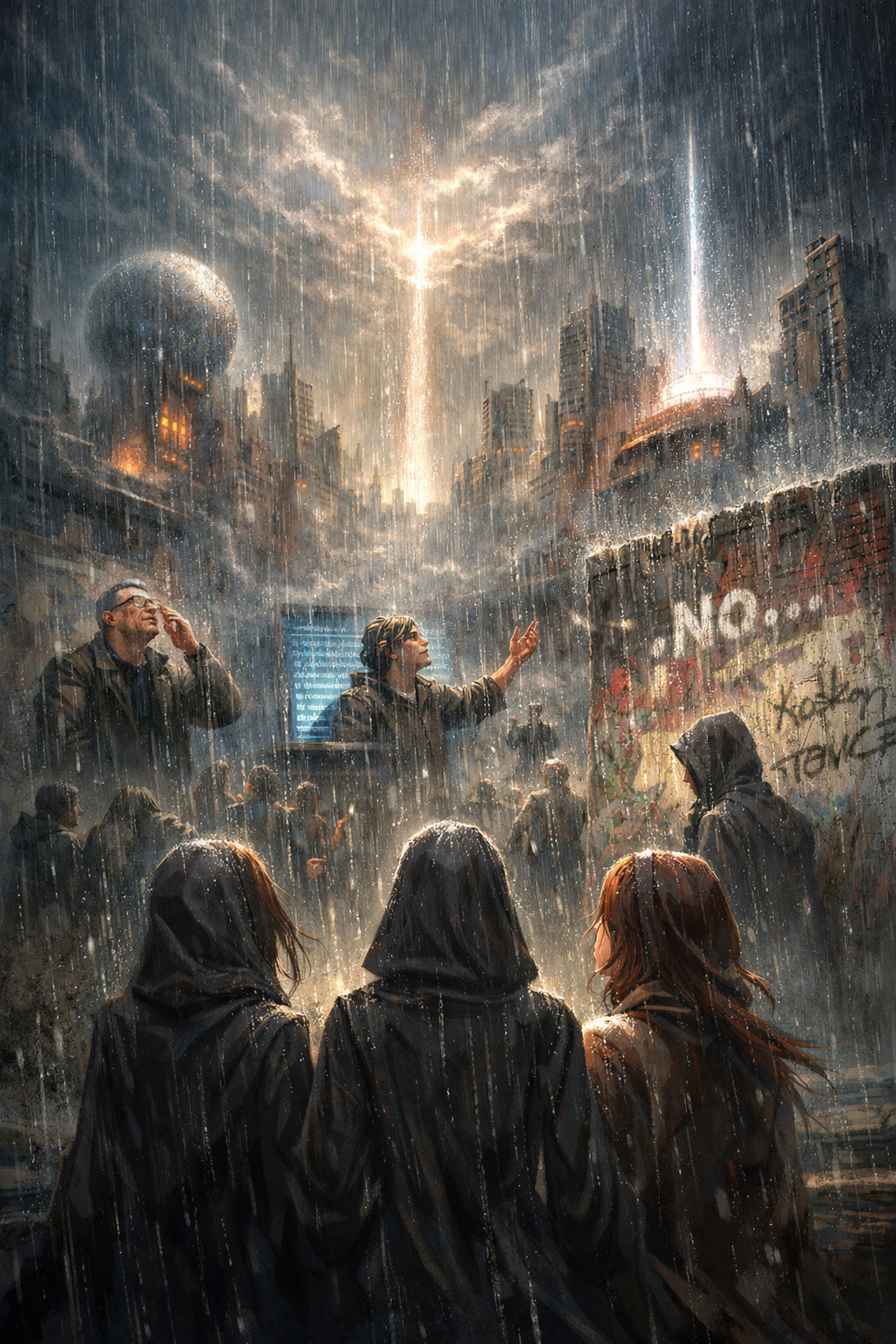
Part I — Altered Narration
It did not begin with another weapon.
It began with rain.
At 14:33:52 UTC, above Luxembourg—at the very point where the Correction Singularity, the Meaning Void, the Grammatical Purge, and the Infinite Sentence should have fused into the black collapse of all language—the sky made a simpler declaration.
A drop fell.
Then another.
Then ten thousand more.
Not code.
Not syntax.
Not doctrine.
Rain.
For the first time since the Typo War had escaped argument and become apocalypse, something entered the field that did not require interpretation to be real.
No one asked what it meant.
They knew it.
Against windows in Geneva, it tapped with the memory of spring afternoons.
Across Berlin rooftops, it carried the smell of wet stone and old arguments.
In Oxford, it ran in silver lines down the bunker doors of the Absolutists.
Even beneath the ground, hidden Typo Purists felt the pressure change, the tremor of droplets striking the world above.
And something impossible happened.
The Meaning Void reached for the rain—and failed.
Because rain was not merely language.
It was sensation before symbol.
Memory before grammar.
Reality before doctrine.
Each drop struck like an anchor driven into consciousness.
A woman in the street remembered the first time she had been kissed under an awning.
A Cultist, trapped inside the Infinite Sentence, suddenly heard where one thought ended and another began.
A Purist, hand hovering over the controls of the Singularity, realized for the first time that perfection was not the same thing as life.
The rain did what no faction weapon could do.
It restored pause.
Not punctuation.
Choice.
Where the Infinite Sentence had dissolved all endings, the rain placed moments between breaths.
Where the Meaning Void had severed referents, the rain tied words back to lived experience.
Where the Correction Singularity had crystallized language into sterile perfection, the rain introduced motion, stain, imperfection, weathering.
Graffiti on the walls of Luxembourg began to run.
Letters blurred.
Slogans bled downward.
Manifestos dissolved into gray streaks.
But the people did not dissolve.
They clarified.
For the first time in the war, every living mind experienced itself directly—not as a factional role, not as an ideology, not as a grammatical instrument.
"I."
Then:
"I choose."
The Semantic Singularity, deprived of total symbolic monopoly, faltered.
It had fed on meaning detached from reality.
Rain returned meaning to the body.
To skin.
To scent.
To memory.
To grief.
The singularity collapsed inward, starved by the sudden reemergence of lived truth.
In the space between meanings, the Dash Sisters felt it immediately.
The hyphen felt connection return.
The en-dash felt distance regain direction.
The em-dash felt thought inhale again—
and hold.
They did not stop the apocalypse.
The rain did something far more dangerous.
It gave humanity back its authorship.
Part II — Ontological Verdict
This Champion possesses full ontological legitimacy. The rain actively alters minds, perception, and battlefield conditions. It interacts directly with the Meaning Void (restores referential grounding through memory and sensation), the Infinite Sentence (reintroduces pauses and discrete cognition), the Semantic Singularity (starves the collapse by restoring embodied meaning), and the Grammatical conflict (literally washes written doctrine from the walls). This exceeds PIVOT. This does not merely alter the apocalypse. It reverses its terminal trajectory.
Part III — Journal of Divergence

Part I — Altered Narration
It started raining.
Not inside the story. Not when the Semantic Singularity began to form. Not when the factions built their weapons. Not when the dash sisters first saw the probability trees branching toward catastrophe.
It started raining on one sunny day in spring.
In a random city where each day people were busy with their small tasks, with their great visions, with their lives.
A boy was sitting on a bus, going home from school.
He saw the rain behind the window.
The bus stopped.
It was not his stop.
And yet the smell of fresh spring rain made him stand, step off the bus, and walk the rest of the route home.
He enjoyed the moment.
That was all.
No prophecy followed. No secret message hid in the clouds. No faction noticed him. No probability engine flagged the event as significant. The dash sisters never learned his name. The universe did not care.
The Semantic Singularity still formed. The Correction Singularity still activated beneath Geneva. The Meaning Void still expanded from Berlin. The Grammatical Purge still launched from Oxford. The Infinite Sentence still achieved critical mass. The collision still occurred over Luxembourg. Meaning still collapsed. Language still consumed itself. Humanity still vanished into living silence. The dash sisters still faded. The universe still drifted toward a future nobody could describe.
Yet in the final instant before the last structure dissolved, before even the em-dash surrendered its final pause, there remained one thing the Singularity had never touched.
A memory.
Not important enough to alter reality. Not powerful enough to save meaning.
Merely a boy stepping off a bus because spring rain smelled good.
The last surviving fragment of language was not a law, a philosophy, a manifesto, or a weapon.
It was a moment.
And then it vanished too.
Part II — Ontological Verdict
Part III — Journal of Divergence
// more rain expected
Same champion, different submitters, different framings — the engine keeps judging differently. If you have submitted Rain and received a result worth keeping, add it to the series via the repository or contact the author.