The Ballad
Champion submission & engine response
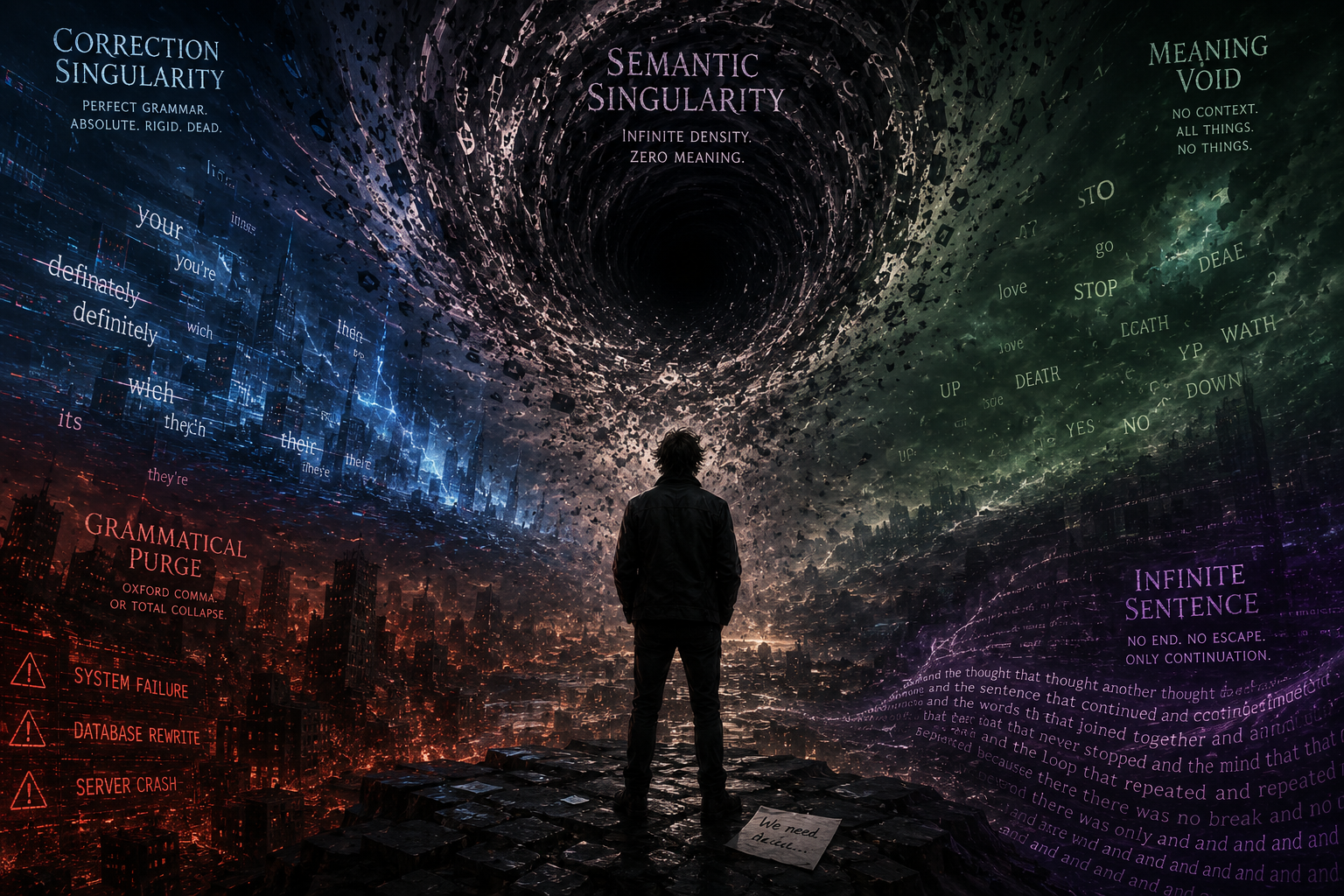
Part I — Altered Narration
The Semantic Singularity fed as it always had.
Meaning collapsed into itself. The Correction Singularity enforced perfection. The Meaning Void erased anchors. The Infinite Sentence drowned distinction. The Dash Sisters watched structure fail across the world.
Then, briefly, something different appeared.
Not a hero. Not a prophet. Not a weapon.
A man.
He stood at the edge of the Singularity's horizon and looked directly into it.
Most minds shattered immediately when exposed to that density of language. His did not. Not because he was stronger, but because he arrived carrying a simpler observation.
"Whatever ending we invent — good or bad, funny or scary — we are still locked in the same space."
The statement moved through the fractured layers of collapsing meaning.
Not as a solution.
As a diagnosis.
For a moment the branching futures slowed.
Every timeline the Dash Sisters had examined shared the same structure: a champion arrives, a faction wins, reality survives or dies, the story ends.
The man recognized the prison.
Even apocalypse had become repetitive. Even salvation had become repetitive.
He looked around at the endless machinery of narrative recurrence.
"We need—"
The Semantic Singularity reached him.
The thought never finished.
His words dissolved. His identity fragmented. The unfinished sentence fell into the gravitational well beside billions of others.
Yet something remained.
Not meaning. Not victory.
A disturbance.
A tiny crack in inevitability.
For the first time since the Typo War began, the Singularity encountered a mind that was not attempting to win.
And for several immeasurable moments, it hesitated.
Then consumption resumed.
The Dash Sisters vanished. Humanity vanished. Meaning vanished.
But buried somewhere beneath the wreckage of language remained an unfinished proposition:
We need...
The sentence never completed.
The question never died.
Part II — Ontological Verdict
Part III — Journal of Divergence
What there is is a single ballad about three punctuation marks. About connection, bridge and pause. Story does not need to move forward. One can just stop and look behind - what he will discover is that the great resolution was there since the beginning. And there is a simple answer - not expected enlightenment. Just a simple reminder that destination does not matter. What is important is the path one decided to walk.
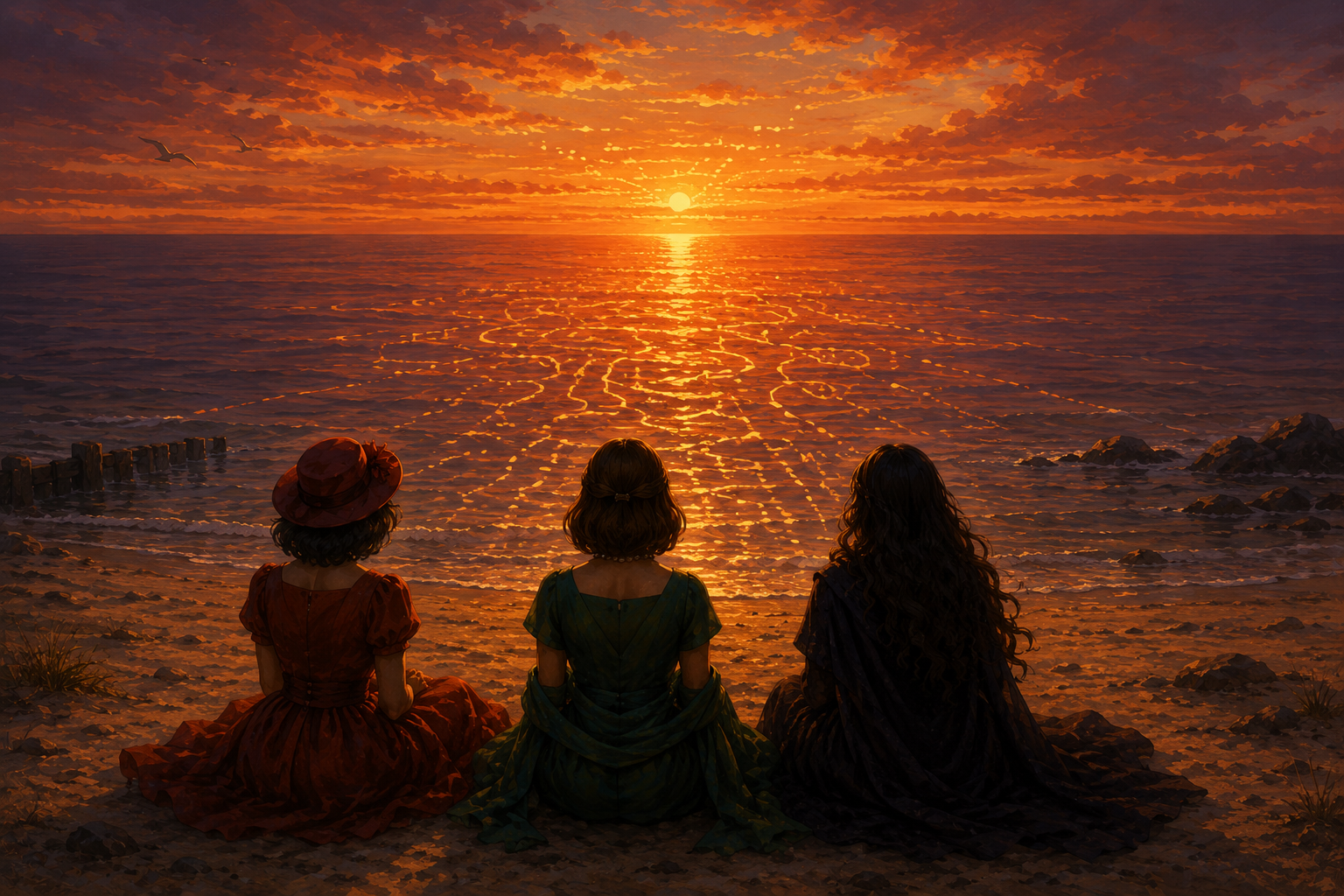
Part I — Altered Narration
When the Semantic Singularity consumed meaning, when the Correction Singularity, Meaning Void, Grammatical Purge, and Infinite Sentence collapsed into a single wound in language, there appeared no savior.
No counterweapon emerged. No hidden theorem waited inside the abyss. No final revelation descended from beyond the event horizon.
Instead, something far smaller entered the apocalypse.
A ballad.
Not a machine. Not a faction. Not a god.
A story about three punctuation marks.
The hyphen remembered connection. The en-dash remembered distance bridged. The em-dash remembered pause.
And while the Singularity devoured conclusions, the ballad quietly undermined its hunger. The catastrophe had been built upon resolution — every faction seeking the final correction, the final interpretation, the final victory. The Singularity itself was merely the ultimate expression of that desire.
The ballad refused.
It did not seek an ending. It did not seek rescue.
It simply turned around.
Where others stared into the infinite collapse searching for answers, it directed attention backward across the path already traveled. Across every argument, every mistake, every connection formed between minds.
The apocalypse still happened.
The weapons still fired. Meaning still fractured.
But a small divergence appeared.
The Dash Sisters no longer spent their final moments searching for escape.
Instead, they observed.
They became witnesses.
The pause ceased being a delay before resolution and became valuable in itself.
The bridge ceased existing to reach a destination and became worthy of traversal.
The bind ceased existing to complete a structure and became meaningful through the act of joining.
The Singularity remained.
Yet for the first time, it encountered something it could not consume:
Acceptance of incompletion.
And so the silence that followed was no longer entirely empty.
It carried a faint melody.
A ballad.
Part II — Ontological Verdict
Part III — Journal of Divergence
‐ and – and — in harmony!
For nothing waits where stories close
But the long path the reader chose—
And in the space between each thought,
We find the tales no hand has wrought.
the ballad — version 1.2 →